2025 Gambling Statistics

Profile Image
Erik King
Editor in Chief - Zamsino

Numbers shape how we understand gambling, from the odds behind roulette to the economics of sportsbooks and lotteries. For operators, they signal market performance, for players, they help frame risk and reward, and for policymakers, they inform regulation and consumer protection. Taken together, the figures reveal how people around the world engage with games of chance and skill, both online and on land.

This upgraded overview organizes key metrics into clear sections, connecting top-line market size with trends by region, product, and player behavior. Where older snapshots appear, they are set in context alongside the wider trajectory of online growth, omnichannel play, and safer gambling initiatives that define the post-2020 landscape. Throughout, definitions matter. Handle refers to total stakes, GGR is stakes minus payouts, and net revenue is what operators keep after bonuses and sometimes taxes, which is why like-for-like comparisons require careful reading.

Gambling Worldwide: A Comprehensive Overview

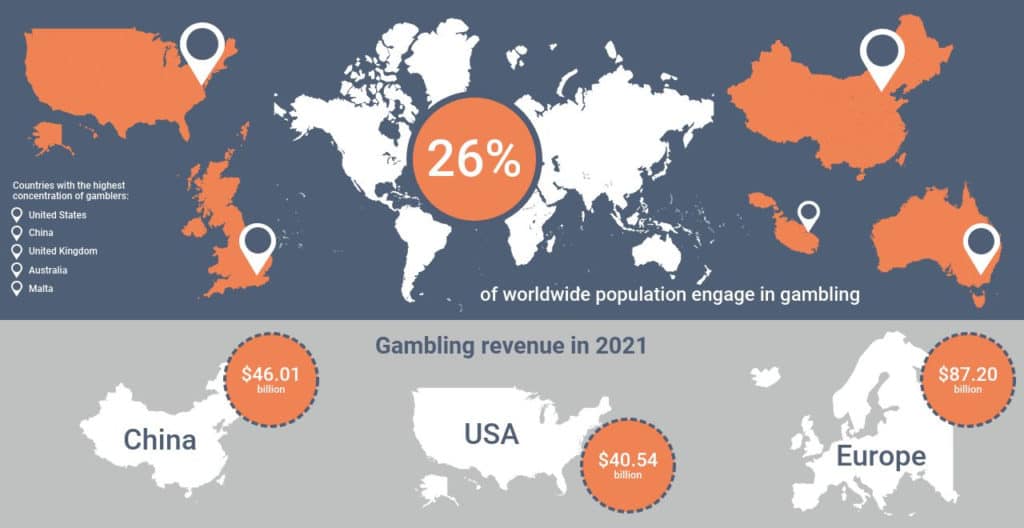
Nearly 26% of people engage in gambling, and 1.6 billion individuals place bets worldwide. Countries with the highest concentration of gamblers include the United States, China, the United Kingdom, Australia, and Malta. These markets span both regulated and gray channels, and participation ranges from occasional lottery play to frequent in-play sports betting and casino sessions. Per-capita spend and product mix differ widely by country, so penetration is only one lens on market performance.

In 2021, China generated the highest gambling revenue at $46.01 billion, followed by the USA at $40.54 billion. Europe’s GGR was €87.2 billion. Land-based casinos accounted for €50.8 billion, while online casinos contributed €36.4 billion. In practice, GGR is stakes minus payouts, while revenue reported by operators is often net of bonuses and taxes, so definitions matter when comparing numbers across sources. Regional totals also ebb and flow with currency movements, tourism cycles, and regulatory changes, which is why multi-year trends are more reliable than single-year spikes.
Gambling Statistics

In Australia, slot machines are a major draw. According to Goodluckmate’s statistics, New South Wales has the country's largest gambling industry, valued at AU$96.56 billion. That dominance reflects the density of pokies in clubs and hotels, a strong racing culture, and consistently high adult participation. Ongoing reforms target harm reduction through data sharing, affordability checks, and stronger identity verification.

Malta is another intriguing gambling destination. Despite its small population, the Mediterranean island records the highest gambling losses per person. Malta is home to many of the world's largest online gambling companies and licensees. Maltese legislation allows both real and virtual gambling, so many providers base their headquarters in Malta to access tax incentives. The Malta Gaming Authority model has also influenced compliance norms across Europe, from licensing suitability checks to responsible gambling controls. As product and payment innovation accelerates, Malta’s focus has shifted to continuous monitoring, technical standards, and cross-border cooperation.

Online Betting Statistics

Like many other parts of daily life, gambling has moved online over the past two decades. According to iGB, sports betting surpassed casino games in Europe with a market share of 42.5%. The lottery came in second with 12.6%, followed by poker at 5%, and bingo at 4.3%. The most visible shift is mobile-first behavior, where quick in-play betting and live streaming have increased bet frequency while shortening session length for casual users. In mature markets, mobile accounts for a clear majority of online stakes, helped by faster payouts, biometric logins, and one-tap bet builders.

France generated €691 million through online sports betting in 2018. Over 20% of all wagers in the gaming industry come from mobile-based gambling. In many mature markets, mobile now represents the majority of online stakes, supported by faster payments, cash-out features, and same-game parlays that bundle outcomes into a single ticket. Wallet integrations, instant bank transfers, and clearer transaction histories have also reduced friction while improving visibility into spend.

Despite the enormous popularity of internet gambling, land-based casinos still control a quarter of the worldwide industry. In the U.S., the total income generated by the casino gaming industry is approaching 80 billion dollars. Physical venues remain critical for high-value table play, hospitality-driven experiences, and loyalty ecosystems that converge with digital apps and wallets. Hybrid players often earn rewards both online and on property, a pattern that has increased cross-sell between slots, tables, and sports.

Tip

When reading market reports, check whether a figure refers to handle, GGR, or net revenue. A large handle does not necessarily mean high revenue if payouts are elevated by favorites winning or by generous promotions.

The Biggest Gambling Destinations in the World

Let's look at the concrete statistics for the top 6 gambling destinations and each gambling center’s total revenue. These markets combine regulation, tourism, and product variety in different ways, which explains why growth rates and player mixes vary. Differences in tax policy and advertising rules also shape the share of online versus retail play.

USA

In 48 U.S. states, some form of gambling is permitted, with Utah and Hawaii being the only states that do not allow gambling. Las Vegas is one of the country's fastest-growing metros. Casinos in Nevada generated $13.4 billion in gambling income in 2021. Las Vegas and regional casinos drive table and slot play, while tribal gaming is a major part of the national footprint. Tiered loyalty programs, cashless slot wallets, and app-linked offers align online and on-property journeys.

Card games, lotteries, and other online casino games are among the most popular gambling activities in the U.S. U.S. states generated a substantial amount of US$240 billion in revenue. Since 2018, legalized sports betting has rolled out across dozens of states, with mobile wagering now the dominant channel in states that allow it. A small but growing number of states also regulate online casino and poker, extending play beyond the casino floor. Marketing has shifted from customer acquisition at any cost to sustainable retention, clearer terms, and stronger responsible gambling tools.

In 2018, the restriction on sports betting was relaxed, which encouraged the participation of U.S. bettors. A survey in March 2020 revealed that 13% of more than 2,100 U.S. respondents placed bets on sporting events. As apps have matured, features like live same-game parlays, low-stake micro-bets, and fast withdrawals have expanded mainstream appeal while also prompting stricter ad and responsible gambling rules. Geolocation, KYC, and tax withholding keep the ecosystem compliant while preserving a smooth user experience.

UK

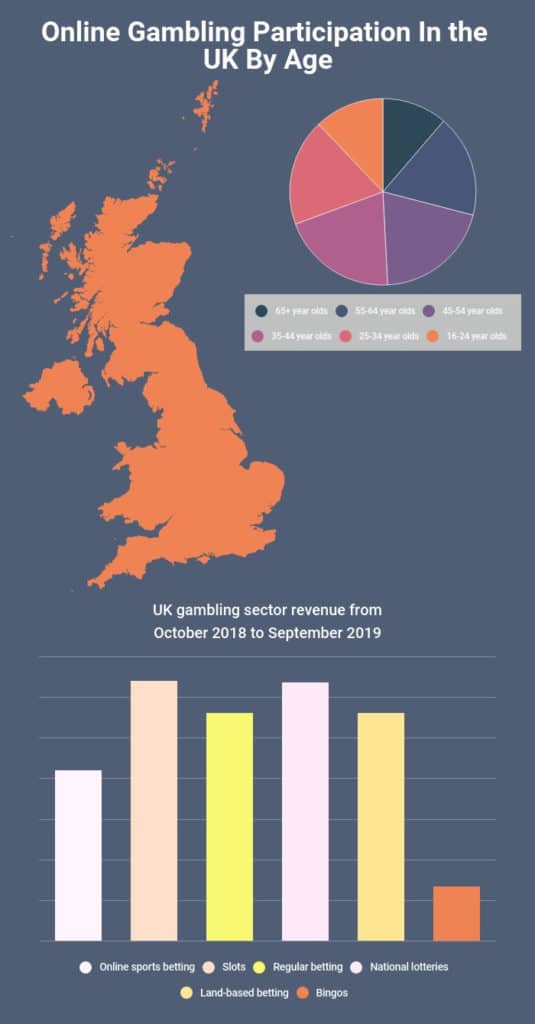
The UK Gambling Commission has regulated gambling in the UK since 2005. Top gambling activities include casino slots, football, horse racing bets, and national lotteries. Most online gamblers in the UK are between 35 and 44. The UK is also known for robust safer gambling measures, including self-exclusion tools, affordability checks, and limits on bonus structures. White paper reforms continue to evolve stake limits for online slots, enhanced checks for high and medium-risk accounts, and clearer protections for younger adults.

From October 2018 to September 2019, the sector generated £14.3 billion. It splits into the following sections: Online sports betting – £2.1 billion Slots – £3.2 billion Regular betting – £2.8 billion National lotteries – £3.18 billion Land-based betting – £2.8 billion Bingos – £668 million.

Online sports betting reflects the nation’s football-first culture, with in-play and cash-out as core features. Slots remain the online workhorse, with tighter spin speeds and clearer RTP disclosures. Regular and land-based betting centers on horse and greyhound racing alongside football accumulators. National lotteries deliver broad participation at small stakes, funding good causes. Bingos have transitioned to hybrid social play, both in clubs and online rooms.

UK Gambling Statistics

China

Gambling is a heated topic in China. State-run lotteries serve a population of more than 1 billion people, while internet gambling is prohibited. Offshore operators target demand, but enforcement remains strict. Payment and advertising restrictions keep the domestic online market closed, and messaging focuses on sports engagement rather than betting.

Macao is a significant global gambling center. This Special Administrative Region of China hosts more than 42 casinos and is the only part of China where gambling is fully permitted. Recent years have seen a strategic pivot from junket VIP business to mass and premium mass segments linked to broader tourism and entertainment. Operators have diversified with non-gaming amenities, which supports more stable revenues through travel cycles.

The market income for esports gambling in China increased to 140 billion yuan in 2021, a 2.65% increase from around 136 billion yuan the year before. Esports and virtual events have become popular with younger bettors, although regulation keeps formal betting constrained. Media rights, streaming, and tournament prize pools continue to grow, feeding adjacent interest.

In 2021, baccarat, slots, roulette, mahjong, and football lottery brought over US$10.3 billion to the city’s gross revenue. As travel normalizes, integrated resort investments aim to diversify revenue with conventions, shows, and retail that complement gaming. Risk controls have tightened around high-roller play, while digital payments and loyalty programs enhance the mass market experience.

Canada

While each Canadian province has its own casino legislation, Canadians have easy access to internet gambling. More than 75% of Canadians have taken part in various gambling activities. Saskatchewan records the highest gambling spend per adult in the nation at $841. Provinces operate their own online sites, and some also permit private operators within provincial frameworks. Ontario’s competitive regulated market model has influenced broader debates on licensing and advertising.

It is estimated that the gambling industry collected CAD 13.5 billion in revenue in 2017. The lottery is the most lucrative form of gambling in Ontario, with strong lottery sales that consistently outpace other verticals. Other popular forms of gambling include scratch cards, slot machines, and esports betting. In the largest provinces, regulated online marketplaces have expanded choice while adding consumer protections and advertising guidelines. Marketing standards emphasize clear odds, age gating, and limits on athlete endorsements.

Australia

Gambling is a widely permitted leisure activity in Australia. Top gambling activities include pokies, sports betting, and lotteries. Statistics demonstrate that Australian gamblers are typically between 30 and 49. Regulation has focused on point-of-consumption taxes, advertising controls during live sports, and national self-exclusion tools. Payment rules and identity checks have become more stringent online to reduce harm.

There used to be minimal gender diversity. Women made up only 7.2% of all gamblers in 2011. They now represent 45.8%, approaching the 51% male share of the population. The shift reflects broader adoption of lotteries and online games by women, alongside a persistent concentration of heavy play among a smaller cohort. Community-wide discussions have also driven clearer disclosure of odds, spending tools, and ad frequency caps.

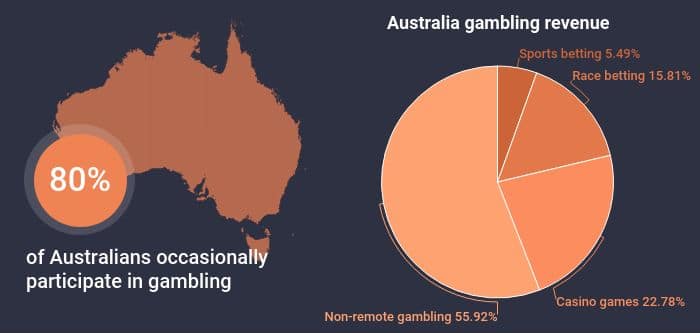
According to statistics, almost 80% of Australians occasionally participate in gambling, contributing to 10% of the state's income. The revenue comes from different gambling forms like: Non-remote gambling – AUD$12.52 billion Casino games – AUD$5.10 billion Race betting – AUD$3.54 billion Sports betting – AUD$1.23 billion.

Non-remote gambling covers pokies in clubs and hotels, which remain the largest contributor. Casino games include both table play and slots inside dedicated venues. Race betting reflects the deep cultural roots of thoroughbred and harness racing. Sports betting continues to grow online with live markets and mobile-first offers, even as advertising faces tighter time-of-day restrictions.

Australia Gambling Revenue

Recent policy changes include tighter ID checks, limitations on credit card use for online gambling, and expanded data sharing to identify high-risk patterns, all intended to lower harm without eliminating recreational play. Operators increasingly publish annual sustainability reports that track interactions, self-exclusions, and interventions.

Singapore

Singapore established its first casino in 2010. Since then, it has become a top gambling hotspot in South East Asia. Introducing casinos in Singapore sparked public anxiety about addiction and financial ruin. The market is anchored by two integrated resorts that blend gaming with luxury tourism. Non-gaming attractions have grown, reinforcing tourism-led demand.

The government discourages locals from gambling by charging an admission fee of $81 for those who want to enter the casino. Under the Family Exclusion Orders, families may also prohibit members from going to the casinos. However, these initiatives have not had much of an effect on the nation's gambling culture. Remote gambling remains tightly controlled, and social safeguards continue to evolve with technology and payment methods. The regulator has prioritized stronger account-level monitoring and targeted education for at-risk groups.

Interesting Gambling Facts From Around the World

Most people love to test their luck. Some get hooked on the thrill, while others do it just to unwind. Want to know some surprising gambling facts from around the world? These snapshots cover participation, outlier wins, and market size. Definitions and sources vary, so ranges are common across publications.

Here are a few figures that are sure to startle you. A whopping 1,560,000,000 people worldwide have indulged in gambling practices. Men bet twice as often as women. Almost 85% of all Americans have wagered in their life. The international online betting market is worth $450 billion. In 2003, Las Vegas' Excalibur Hotel-Casino paid the most generous jackpot for slot machines (US$39,713,982.25). Gambling income accounts for half of Macau's total revenue. Every year, Australians spend $18 billion on online gambling. Nevada has more than 5,510 casino games, making it a critical U.S. gambling market.

Across regions, the mix of products and bet sizes varies widely, but the combination of convenience, entertainment, and payouts keeps participation high. Outlier jackpots can dominate headlines, though most players engage at modest stakes for short sessions.

Gender-Related Gambling Patterns

Gender significantly influences gambling since men and women display contrasting patterns. Men bet more frequently and spend more on betting. Comparatively, women are more likely to prioritize fun and focus on staking smaller sums. Marketing and product design also shape preferences, from sports-centered apps to casual lottery and bingo experiences. In product testing, personalizing based on behaviors like speed of play and deposit frequency is more predictive of risk than gender alone.

Let's see the gender-specific gaming statistics that point out some of the most significant disparities. 43.5% of male UK citizens in June 2021 took part in at least one game. 39.8% of women in the UK gambled at least once in June 2021. Male and female gaming participation rates have decreased since June 2017 due to increased addiction awareness. Compared to women, men appear to be more prone to gambling and gambling-related disorders.
* Around 67% of females and 73% of males in New Jersey have gambled in the last year.

In many markets, women’s participation has risen online, narrowing the gap but not eliminating differences in frequency and risk. Operators that personalize limits and alerts by behavior rather than demographics tend to detect harm earlier. Clearer onboarding, optional budget tools, and timely reality checks support healthier patterns for all players.

The Increasing Popularity of Online Casinos During COVID-19

While COVID-19 reshaped our daily lives, the online gambling market thrived. The pandemic brought worry and anxiety, so people turned to online activities to keep themselves engaged. Lockdowns accelerated digital adoption, and features like live dealer tables and virtual sports filled gaps left by suspended leagues. Player journeys became more app-centric, with chat support, faster payouts, and tailored offers keeping engagement high.

In October 2021, the highest number of bets were placed worldwide. Roughly 6,120,476,686 bets were placed on slot machines, 275,480,062 on live events, 80,664,453 on poker, and 335,585,894 on other casino games. By late 2022, retail reopened, yet many players kept hybrid habits, mixing app-based betting with occasional venue visits. Loyalty programs now frequently recognize both online and in-venue activity.

December 2021 saw the highest gross gambling yield, with £200,186,689 on slots and £141,985,160 on actual event betting. Virtual betting saw a hefty £6,125,645 GGY and £62,707,725 on casino games. Since then, regulators have tightened rules around bonuses, autoplay, and ad targeting, balancing growth with consumer protection. Operators that invested early in risk detection and clear messaging have retained more of the post-lockdown cohort.

The Toxic Face of Gambling: Facts and Statistics

People often picture only the glitzy world of Las Vegas. But gambling has its downsides too. With an increase in gambling opportunities, gambling problems are on the rise. Unsettling gambling addiction statistics show how this issue can affect anyone. Harm can include financial stress, relationship strain, and mental health issues, even among people who do not meet clinical thresholds. Financial counseling and support networks are important complements to platform-level tools.

The most frequent sufferers of gambling addiction are young adults between the ages of 20 and 30. Recent figures from Georgia State University show that 50% of those who struggle with addiction engage in criminal activity to support their obsession. Early exposure, impulsivity, and easy access to mobile apps are risk factors that can accelerate loss of control. Education in schools and transparent app spending histories can reduce risky escalation.

American problem gamblers comprise about 3% to 5% of the population. People with PTSD exhibit elevated rates of problem gambling, and 34% of bettors who seek treatment also exhibit signs of PTSD. Practical mitigations include deposit and time limits, cooling-off periods, self-exclusion, and transaction blocks with banks, all of which are more effective when combined with professional support. Platforms now use interaction prompts and affordability checks to reach players before harms compound.

Pitfall

Chasing losses by increasing bet size after a downturn is a common pattern that often deepens harm. Pre-set limits and taking breaks interrupt that spiral more reliably than any system.

Famous Online Casino Games

In contrast to the decline of skill games and poker betting, both sports betting and casino gambling have increased since 2007. Lottery games have also become more popular, but at a much slower pace. Product innovation has shifted toward immersive formats, branded content, and faster bet cycles that appeal to casual audiences. Live dealer studios have grown quickly by replicating table play with social elements and real-time results.

Slot machines are the most well-known casino games in the U.S., UK, and Australia. For American casino patrons, blackjack is the game that follows slots and poker. Baccarat leads high-limit play in several Asian markets, with volatility driven by large average bet sizes rather than long session length.

Slots

Branded slots are rising in popularity. Players with strong brand affinity are more likely to try slot games featuring their favorite characters. The most played branded slot games are Jurassic Park, Westworld, Batman, and Game of Thrones-themed titles. Behind the scenes, mechanics like RTP, volatility, bonus frequency, and max exposure determine both game feel and operator margins. Studios iterate on math models to balance entertainment, longevity, and peak win moments.

On the other hand, progressive jackpots have been the source of incredible winnings, with players scoring payouts of $5 to $7 million. Networked progressives accumulate across many sites, while local jackpots grow within a single casino, producing more frequent but smaller top prizes. Clearer disclosures on contribution rates and seed values help players understand how these pools build.

Lottery

Many nations allow lotteries, including those that forbid conventional betting and casino-style gambling. In 2010, approximately 49% of Americans reported playing the lottery. Lotteries, claims Gambling ‘N Go, make up around 6% of the gaming audience. Subscriptions and app-based ticket management have made participation more convenient without changing the core draw format. Responsible play tools now include spend caps and reminders ahead of big rollover draws.

Since then, EGBA forecasted an increased percentage of online gaming. Lotteries rose from 2.3% to 4% between 2013 and 2016. The lottery payouts from 2012 to 2015 increased by 22% in the UK, going from £3.38 billion to £4.13 billion. Syndicates and instant win games have added variety, attracting players who prefer small stakes and simple rules. Charity-linked raffles have also benefited from digital distribution, broadening reach.

Sports Betting

According to Gambling ‘N Go, sports betting is the most well-liked form of gambling. You may wager on a player, a team, a goal, or potential runs. Many people make online sports bets using cryptocurrencies. Participation rates are substantially greater for college students who indulge in small sporting events. Live betting, cash-out, and same-game parlays have become defining features that increase engagement across full seasons. Pricing engines update odds in milliseconds, and traders manage risk by limiting correlated outcomes.

Example

A bettor stakes $20 on a team at decimal odds of 2.50. If the bet wins, the return is $50, which is the $20 stake plus $30 profit. This simple frame helps new bettors compare potential outcomes across markets.

Card Games

In the U.S., World Series of Poker winners take home between $7 to $10 million. The largest online competitions get enough participants to provide the first reward of $1 million. In Nevada, players may earn up to 143 million dollars in poker games. On the other hand, Australia is well-known for having many poker players. For table games like blackjack and baccarat, house edge, rule variants, and side bets drive both player strategy and operator results. Live dealer formats and hybrid tables with electronic betting terminals have lowered minimums and broadened access.

Bright Future of Gambling

Online gambling is snowballing. Technological advancements worldwide are driving more companies to battle for players' attention and increasing wagering activity. Gambling has a promising future globally, with experts predicting the $635 billion revenue to hit the one trillion mark. Growth will not be uniform, but omnichannel ecosystems, cashless payments, and better risk detection are common threads. Consumers increasingly expect seamless account management, instant payouts, and consistent rewards across devices and venues.

Cash revenues are estimated to reach $21.14 billion in the U.S., while online gambling revenues may hit $4 billion in the UK. According to Morgan Stanley's “Macao 2022 – Power of Compounding” analysis, the gambling sector in Macao might reach $53 billion by 2022. The European countries already make up the most significant portion of the industry at 57% and are expected to hit even higher rates. Looking ahead, AI-driven personalization, product localization, and stricter advertising and affordability checks will shape sustainable growth, with operators competing on trust and user experience as much as on odds and jackpots. Markets that balance innovation with clear standards tend to deliver steadier long-term returns.

Data Sources